 Skip to content

Manchester United enter the closing stretch of November in crisis mode, with a growing injury list and several key players ruled out for weeks. This is one of the most difficult periods of the Rúben Amorim era, not only because of the absentees, but also due to the team’s alarming dip in form and mounting pressure from supporters.
Ahead of the away trip to Crystal Palace, United sit 10th in the Premier League table after 12 matches, with only 18 points, 15 goals scored and 20 conceded — one of the club’s poorest starts in the Premier League era. All these factors put Amorim in a position where he simply cannot afford further mistakes.
Manchester United’s Squad Situation Before the Match
Rúben Amorim has confirmed several major absences, particularly in attack — an area that was already unstable from the start of the season.
Notable players sidelined:
- Benjamin Šeško – knee injury, expected return mid-December
- Matheus Cunha – muscle injury, could return for the West Ham match
- Harry Maguire – undisclosed injury, confirmed out
- Tyrell Malacia – yet to play a single minute this season
- Victor Lindelöf – recently returned but not match-fit to start
- Casemiro – hamstring injury since October, projected return late December
In this situation, United are left with only Højlund, Garnacho, Rashford, and Bruno Fernandes as their reliable attacking options — a severe shortage for a system heavily dependent on intensity under Amorim.
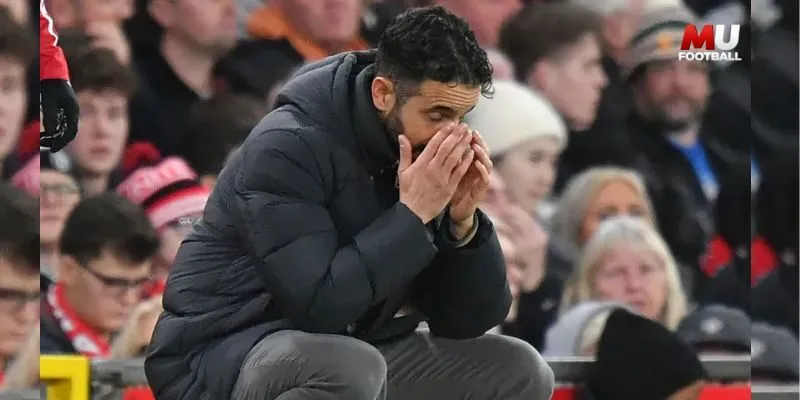
Mounting Pressure on Rúben Amorim
The Manchester United manager has struggled to put the team on the upward trajectory fans expected, and the pressure on him is building quickly.
Away Form Woes — United’s Persistent Headache
Manchester United have won just 1 of their last 11 Premier League away matches.
This season alone:
- 3 defeats away
- 2 draws
- Only 1 victory
Even more worrying: United concede 1.8 goals per game on the road — a number completely at odds with the pressing-focused, balanced defensive structure Amorim built at Sporting.
United’s poor away form is now one of the clearest indicators of tactical fragility and lack of confidence. The team often start slowly, struggle to impose their rhythm, and collapse under pressure during key moments.
League Position and Amorim’s Own Frustration
After 12 rounds, United sit 10th, 10 points off the top four. Amorim openly admitted in a recent press conference: “We are not controlling matches, not maintaining the tempo when needed, and we lack composure in key situations.” Such unusually candid criticism shows the internal pressure he is facing — from results, from injuries, and from expectations.
Why Manchester United Are Falling Into a Form Crisis
The team’s inconsistency is not solely due to injuries — the issues run deeper.
Thin Attacking Options & Over-reliance on Individuals
United’s attacking structure relies too heavily on:
- Bruno Fernandes – creativity and link play
- Alejandro Garnacho – unpredictability and dribbling
- Rasmus Højlund – focal point of the attack
Meanwhile:
- Rashford is badly out of form, with only 3 goals in 15 matches, a major decline from his 30-goal season in 2022–23.
- With Šeško and Cunha sidelined, United have no rotation options and no tactical alternatives in forward zones.
In their last five matches, MU have scored only 4 goals — the lowest among the league’s top 10.
Imbalance Between Pressing, Ball Control & Transitions
One of United’s biggest problems is the lack of synchronization between pressing, possession, and transitions.
- United often press high, but fail to maintain compact distances, leaving exploitable gaps behind their midfield.
- When in possession, the team lack a stable build-up structure, making it difficult to sustain tempo or progress into the final third.
- In transition, the absence of pace from Šeško and Cunha reduces counter-attacking threat, while their defensive recoveries after losing the ball have significantly weakened.
This misalignment across all three phases creates a vulnerable United — easy to bypass, easy to pressure, and lacking identity.
Tactical Forecast & Expectations for the Crystal Palace Clash
Given the injury crisis, Rúben Amorim is almost certain to retain his three-centre-back system but with reduced risk-taking from the wing-backs. United will prioritize spatial control rather than heavy possession, minimizing exposure to Palace’s direct transitions down the flanks — a weakness that has cost United repeatedly in recent away fixtures.
Bruno Fernandes may drop deeper to stabilize the build-up, while Garnacho and Højlund will act as the primary outlets for fast transitions. With such a depleted attack, United cannot expect an explosive performance — discipline, compactness, and pressing resistance will be the key targets.
Considering United have won only 1 of their last 11 away matches, even a narrow victory or a hard-earned point at Selhurst Park would be a realistic outcome. This match is less a test of firepower and more a test of whether United can restore tactical stability or continue spiraling through a prolonged cycle of inconsistency.